
For your convenience, we have installed the link below to make donations to this website easier. Now you can utilize your PayPal account or your credit card.

--------------











---------
We also have a Business Card Page. Click here.
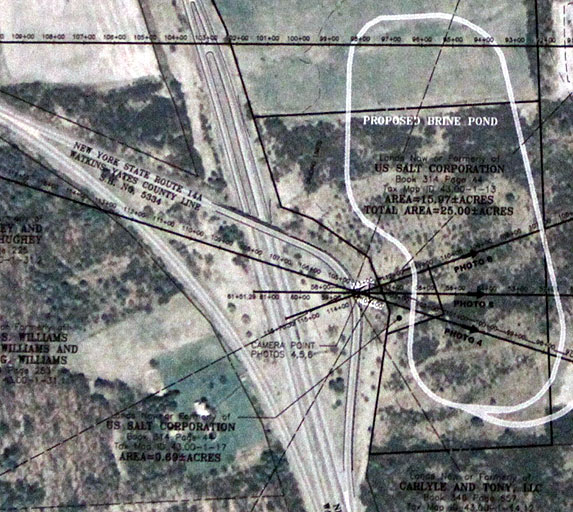
Aerial view shows location of the proposed brine pond (outlined at right) along Rt. 14, near the Rt. 14A ramp.
Inergy
outlines its case for propane storage project
 WATKINS
GLEN, April 14 -- An estimated 200 people were on hand Wednesday night
as the Inergy company -- owner of U.S. Salt -- explained its proposed
propane storage project west of Seneca Lake and north of Watkins Glen.
WATKINS
GLEN, April 14 -- An estimated 200 people were on hand Wednesday night
as the Inergy company -- owner of U.S. Salt -- explained its proposed
propane storage project west of Seneca Lake and north of Watkins Glen.
Inergy Senior Vice President William Moler told the audience that propane and natural gas have been stored in salt caverns in that area for years, that this is an extension of that practice, that there is no chance of contaminating Seneca Lake, and that the brine pond that has drawn opposition is safe and essential to maintaining the structural integrity of the caverns.
Moler, with help from industry spokesman Roland Penta -- owner of Phelps Sungas and chairman of the National Propane Gas Association -- explained the nature of propane (a clean burning, non-toxic fossil fuel that is essential to millions of residents throughout the nation), looked at the controversy surrounding the cavern project ("a strong disconnect between perception and reality," said Penta, who called himself "a strong proponent" of the Inergy plan), and addressed fears about increasing truck and rail traffic.
 Once
the project is established, said Moler -- and that's assuming the Kansas
City-based company gets the green light for it from the state Department
of Environmental Conservation -- truck traffic will ultimately decrease
because incoming loads will ultimately be eliminated in favor of pipeline
service and minimally increased rail traffic. Trucks will, however, be
picking up loads for outgoing deliveries.
Once
the project is established, said Moler -- and that's assuming the Kansas
City-based company gets the green light for it from the state Department
of Environmental Conservation -- truck traffic will ultimately decrease
because incoming loads will ultimately be eliminated in favor of pipeline
service and minimally increased rail traffic. Trucks will, however, be
picking up loads for outgoing deliveries.
The opponents
Protesters were set up outside the meeting site -- the Watkins Glen Community Center -- bearing signs against LPG (liquid propane gas) storage and against water contamination. But inside, there was no evident discord as Moler spoke with the understanding that he would not take questions while at the podium. He instead encouraged attendees to talk to him afterward and direct any questions they wanted to the company representatives and industry experts set up around the room at stations featuring different topics, such as rail traffic, geology, the physical layout of the project and the like. So if there were any debates, they occurred after his presentation and among small groups, and were hardly noticeable amid the hubbub of people going from station to station.
 The
protesters have their own meeting tonight (Thursday), a session that had
been scheduled before the one Wednesday night was coordinated and announced.
Tonight's meeting, titled "Seneca at a Crossroads: Large-Scale LPG
Storage vs. Tourism, Wineries, Peace & Quiet," will be held from
7-9 p.m. in the Watkins Glen High School auditorium.
The
protesters have their own meeting tonight (Thursday), a session that had
been scheduled before the one Wednesday night was coordinated and announced.
Tonight's meeting, titled "Seneca at a Crossroads: Large-Scale LPG
Storage vs. Tourism, Wineries, Peace & Quiet," will be held from
7-9 p.m. in the Watkins Glen High School auditorium.
Its promotional literature is asking: "Do we want to be the gas storage and transport hub of the Northeast? Do we want LPG stored in our salt caverns? Or do we want agriculture, tourism, home-grown businesses and small-town living? Can industry co-exist with our way of life?"
Speakers will include a member of the Committee to Preserve the Finger Lakes, a research scientist billed as a water quality expert, an environmental health and safety expert, and an ecologist.
Seeking more information
While a number of people leaving Wednesday's session pronounced it "informative" and said it "answered a lot of questions," not everyone was making up their minds before they had heard both sides of the issue.
 Recently
elected Watkins Glen Mayor Mark Swinnerton said that from an economic
standpoint, his village needs such proactive business in the area. "But
from an environmental aspect," he said, "it remains to be seen."
Recently
elected Watkins Glen Mayor Mark Swinnerton said that from an economic
standpoint, his village needs such proactive business in the area. "But
from an environmental aspect," he said, "it remains to be seen."
Inergy's Moler "answered some concerns," said Swinnerton. "But there still are some unanswered questions about groundwater. I'm going to make a decision on how I feel. But I was born and raised here, and Seneca Lake's water runs in my veins. My job is to protect the lake. I have to educate myself more about these plans, which are outside the village but would have an effect on all the residents in terms of propane cost, truck traffic and the like."
The Village Board will ultimately weigh in with its opinion on the project, he said, "but whether our stand affects anything, I don't know. We need to be careful on something like this. If there is a miscalculation by the engineers and something (bad) happens, it could be irreversible. I don't want something like that happening on my watch."
County Legislator Barbara Halpin said it was "a very nice presentation, very straightforward. I'll be interested to see what will be said Thursday night. They seemed to cover all the issues tonight. And it says a lot that storage has been going on here for years."
 That
previous storage, dating from 1964, was a major point of the Inergy presentation.
Moler said Teppco stored propane in the caverns from that date until 1984,
and that NYSEG stored natural gas there starting in 1996. This project
would, he said, constitute an extension of that practice designed to keep
propane more accessible and costs from undergoing price hikes as they
did this past winter.
That
previous storage, dating from 1964, was a major point of the Inergy presentation.
Moler said Teppco stored propane in the caverns from that date until 1984,
and that NYSEG stored natural gas there starting in 1996. This project
would, he said, constitute an extension of that practice designed to keep
propane more accessible and costs from undergoing price hikes as they
did this past winter.
Inergy, he said, would rent space to propane companies. "They bring the propane up from Texas or wherever when the price is cheap, and store it. Then they come and get it and deliver it when it's more expensive. Propane costs were up about 15% this past winter. A storage facility like this would have alleviated that spike."
Moler also told the crowd that:
--He couldn't "care less if the Marcellus Shale in New York gets drilled or not. It has nothing to do with us. We've never hydrofractured anything, and we never will. We're getting tangled up with the whole Marcellus drilling debate."
 --The
planned brine pond will be built on a "six percent, gently sloped
open field of hay" off of Route 14 north of Watkins Glen. It's needed
to hold brine when the brine is not in the caverns. When the caverns are
empty of propane, the brine will be filling them up "to maintain
their structural integrity. When the oil goes in (to the caverns), water
comes out because oil and water don't mix." The brine pond, he said,
will be "double lined with a leak detection system. The odds on either
of (the liners) leaking is slim to none. We've had four of these in Savona
for 60 years and never had an issue."
--The
planned brine pond will be built on a "six percent, gently sloped
open field of hay" off of Route 14 north of Watkins Glen. It's needed
to hold brine when the brine is not in the caverns. When the caverns are
empty of propane, the brine will be filling them up "to maintain
their structural integrity. When the oil goes in (to the caverns), water
comes out because oil and water don't mix." The brine pond, he said,
will be "double lined with a leak detection system. The odds on either
of (the liners) leaking is slim to none. We've had four of these in Savona
for 60 years and never had an issue."
--The caverns are "deep, deep, deep" -- ranging from a depth of 2,040 to 2,830 feet below ground. The deepest point of Seneca Lake, he added, is 600 feet, so there is "a distance of about 2,000 feet of impermeable rock" between them, with the lake much higher than the caverns.
The propane "is not going anywhere," he said. "It can't be in contact with the lake unless the lake is really crazy deep, which it is not."
--"All we're doing is replacing product that used to be stored" in the caverns, and planning to do so in an economic climate in which propane "is a growing market."
Photos in text:
From top: Inergy Senior Vice President William Moler; Schuyler County Legislature Chairman Dennis Fagan (white hair) was among those in attendance; protesters outside the Community Center; Watkins Glen Mayor Mark Swinnerton about to be interviewed by TV reporters; attendees were studying charts and maps at stations around the room; Roland Penta of Phelps Sungas.
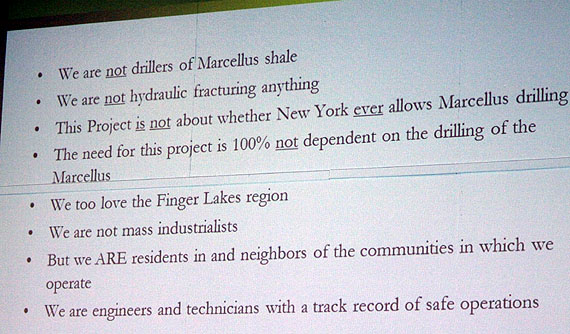
A list presented on the wall behind Moler early in his talk.

Charles Haeffner
P.O. Box 365
Odessa, New York 14869