

Our Primary Pages
Home
Sports
People
Features
Business
Government
Forum
Schools
PSA
Calendar
History
Obituaries
Wine & Tourism
Agriculture

Click here or on the ad above to reach a Chamber of Commerce website.
--------------

Click here or on the ad above to reach the Schuyler County Partnership for Economic Development website
--------------------------------
To go to Jim Guild's Famous Brands website, click on the drawing above or here.
-----------------
Curly's
Family Restaurant, Watkins Glen
 Sponsoring this People page:
Curly's Family Restaurant, located on Route 14 near the P&C Plaza in Watkins Glen. Phone: 535-4383.
Serving breakfast,
lunch and dinner.
Website!! To link to the Curly's Family Restaurant website, you can click on the photo at left or here.
---------------------------

How Bill Green, a lifelong fan of motor racing, became the sport's area historian
Editor's Note -- This is Part One of a a two-part interview of motor racing historian Bill Green conducted by writer Bob Brown, The next part will be: Bill Green Knew Them All -- about the drivers, the owners, and the characters who built American racing, and the kid from Johnson Hollow Road who ended up knowing every last one of them.
Part One
By Bob Brown
WATKINS GLEN, Aug. 12, 2026 -- Bill Green never drove a race car. But for nearly eighty years, he has made sure nobody forgets the ones who did.
He is eighty-five now. Three days a week, you can still find him at work inside the International Motor Racing Research Center (IMRRC) in Watkins Glen. While the entire history of American road racing sits on the center’s shelves, a massive part of it lives right inside Bill’s head. People call him a walking encyclopedia. That is fair, but it misses the heart of who Bill is. An encyclopedia does not get a lump in its throat when the national anthem plays. Bill does. “It’s like, start your engines, let’s go racing,” he says with a smile. “It gives me a warm feeling inside.”
 It all started up on the hill.
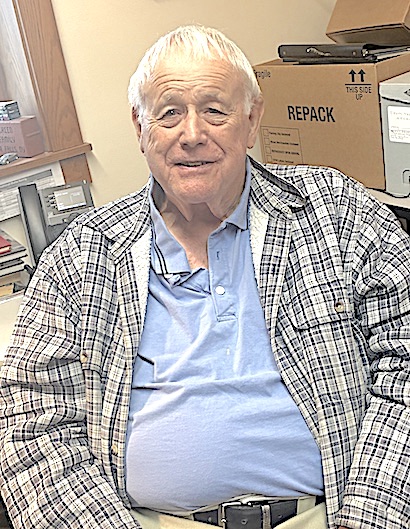
Bill (pictured at right) grew up on Johnson Hollow Road, just above town. Bill’s father died when Bill was only seven; his mother worked tirelessly -- waiting tables at the Hollgate Tavern and milking cows just to make ends meet. Money was tight. When their old ’38 Chevy needed work, they took it to Lester Smalley’s garage. That was about as fancy as life got.
Then came October 2, 1948. His mother asked if he had ever seen an auto race and if he would like to go. He was eight years old. They went, and the moment the cars roared down the main straight in Watkins Glen, swept around the first turn, and climbed over the hill, the boy from Johnson Hollow Road was hooked for life. He can still describe the exact smell of oil and the roaring sound of George Weaver’s Maserati. “As time went on,” he recalls, “we got better sounds and faster cars.” He never truly left that track.
To understand Bill’s passion, you have to picture what Watkins Glen was like back then. The race ran right through the middle of downtown -- six and a half miles of public streets.
During race week, Franklin Street lit up like Times Square on New Year’s Eve. “You were better off walking than trying to drive down Main Street,” Bill laughs. Race cars packed the local garages and gas stations. A kid could walk right up and press his nose against the glass. The Cunningham team worked out of the Ford garage, Stirling Moss hung out at the Chevy garage, and Weaver’s Maserati was tuned at the old Atlantic station. It was a living, breathing museum, and admission was completely free.
Bill jumped into the racing world as early as he could. He and his buddy Bobby King raced their bicycles around the hollow. By 1958, he was a courier at the race headquarters, sprinting messages between desks. In 1959, while still in high school, he did something that showed exactly who he was destined to become: he founded the Watkins Glen High School Sports Car Club. He pitched it to the principal, wrote the bylaws, and got it approved. Bill was elected president. They did not actually own any cars, but nearly fifteen kids joined to watch racing movies and listen to guest speakers. His very first speaker? The local mechanic, Lester Smalley.
Two speakers from those club days stuck with him forever. The second year, Bill landed John Duval, the legendary chief announcer from Syracuse who possessed a voice that could fill an entire valley. Duval’s hand had been withered from an old motorcycle accident, but nothing could touch the power of his voice. Years later, at the 1970 Six Hours race, someone forgot to bring the record for the national anthem. Duval did not blink. He stepped up to the microphone, told the crowd he would perform Canada’s anthem first and then America’s, and sang them both entirely a cappella over the silent grandstands. “It shocked everybody,” Bill says, his eyes lighting up. “That’s the only time that’s ever been done. Ever.”
The following year, Bill went after a true icon: Tex Hopkins. Tex was the famous flagman known for leaping straight into the air with his back to the grid, spinning around as he threw the green flag. He always wore a signature lavender suit, a nod to a group of Washington racers called the Lavender Hill Mob. Bill asked Tex to speak to the club -- and begged him to come in uniform. “For you, I’ll do it,” Tex promised. He stood proudly in front of the Watkins Glen school kids in that bright lavender suit and shared what it was really like to command a race start. The two became lifelong friends. Tex even wore the high school club’s three-inch patch on his sleeve like a medal of honor. You could spot that little Watkins Glen patch in European racing magazine photos showing Tex chatting with world-famous drivers.
Florence Smalley, who recognized Bill’s passion, suggested he learn tech inspection, which became one of the best moves of his life. For the 1960 and 1961 seasons, Bill worked in the tech tent behind Smalley’s garage, checking driver coveralls, helmets, roll bars, and car numbers. He quickly realized that racing is about far more than just the drivers. It relies on the flaggers, timers, scorers, and tech inspectors -- the unsung heroes who camp out all weekend and never get their names in the newspaper. “The sport does not exist without corner workers,” Bill notes. He knew firsthand because he loved being one of the people behind the curtain.
He could have gone to college. He had a rare memory for dates, names, and historical sequences, all filed away like a pristine card catalog. The announcer John Duval had even urged the club boys to get engineering degrees to make life easy on themselves. But a sour teacher turned Bill off from school, and the magnetic pull of the track was simply too strong. “I wanted to be around racing,” he says simply. “And I eventually was.”
The Navy called for him next. Bill signed up for aviation, took an open billet, and shipped out to Great Lakes and Pensacola, where he loved watching the Blue Angels fly. Even while serving overseas, he chased racing wherever he was stationed, falling in love with the fast tempo of European tracks. He considered staying in for twenty years, but home kept calling him back. There were races to see, hills to climb, and a town he loved. He took a machining job for six months, hated it, and then transitioned to working for the Town of Dix. For thirty-two years -- closer to forty once his Navy time was folded in -- Bill drove heavy equipment, mowed roadsides, and plowed snow. But his real life’s work was happening at home. His historic racing collection grew massive. Legendary race founder Cameron Argetsinger and racing historian Charlie Lytle told him which rare books to track down. Bill spent twenty years hunting through swap meets from Hershey to Dunkirk. Today, his collection holds over two thousand books filling three rooms -- and that is not even counting his massive archive of photographs.
He joined the Glen Region of the Sports Car Club of America in 1958. By the time the '70s rolled around everyone simply called him “the historian.” He never asked for the title. His pure passion for racing history filled his life. He was named the IMRRC's historian in 1999. When he retired from his town job in 2001, Cameron Argetsinger brought him on the Research Center staff, and the calling he had been rehearsing for his entire life finally came knocking. “Name your time,” Cameron told him. Bill chose three days a week.
Decades later, he is still there. He guides track tours of the original 1948 street course, digs through archives, and shares his wealth of knowledge on camera for the Center’s videos. While a young producer named Hannah runs the technical side, Bill does what he does best: hooks you with a brilliant racing story you have never heard before.
Bill Green never drove a race car. He just made sure the world would never forget the legends who did. In a historic place built entirely on speed, Bill is the beautiful soul who stayed put.
Meet the Legend Yourself
Want to experience the history of American road racing through the eyes of a man who lived it? Stop by the International Motor Racing Research Center.
Where to find it: 610 S Decatur St, Watkins Glen, NY 14891. Hours: Monday through Friday, 9:00 AM to 5:00 PM. Plan your visit: Bill works his historical magic three days a week. Explore the world-class racing archives, view the latest exhibits, or coordinate a deeper research visit through the IMRRC.
Can’t make it to the track? Follow Bill’s ongoing stories and videos, and submit your own motorsport history questions to him online through the IMRRC’s Facebook and Instagram pages. Come see Bill, hear an untold racing story, and discover the true heartbeat behind the history of the Glen.
racingarchives.org
International Motor Racing Research Center | Watkins Glen NY - Facebook

P.O. Box 365
Odessa, New York 14869