


Our Primary Pages
Home
Sports
People
Features
Business
Government
Forum
Schools
PSA
Calendar
History
Obituaries
Wine & Tourism
Agriculture

Click here or on the ad above to reach a Chamber of Commerce website.
--------------

Click here or on the ad above to reach the Schuyler County Partnership for Economic Development website
--------------------------------
To go to Jim Guild's Famous Brands website, click on the drawing above or here.
-----------------
Curly's
Family Restaurant, Watkins Glen
 Sponsoring this People page:
Curly's Family Restaurant, located on Route 14 near the P&C Plaza in Watkins Glen. Phone: 535-4383.
Serving breakfast,
lunch and dinner.
Website!! To link to the Curly's Family Restaurant website, you can click on the photo at left or here.
---------------------------

Ed Clute reflects on a music-filled life:
'Play it with feeling. That's the whole story.'
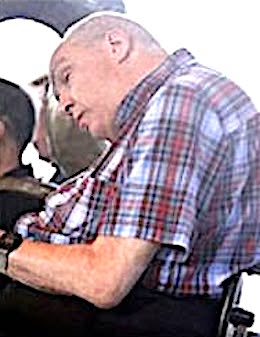
Editor's Note on July 11, 2026 -- Area musician Ed Clute, one of The Odessa File's selections as an Essential part of Schuyler County (see here), is currently residing at Seneca View Skilled Nursing Facility in Montour Falls, where local writer Bob Brown interviewed him and where Mr. Clute reflected in some detail on his remarkable career. The two photos are from The Odessa File archives.
First, from Bob Brown:
Ed Clute has been called quite possibly the hardest-swinging stride pianist you've ever heard. Born sightless in 1943 into one of Watkins Glen's most prominent families -- his grandfather, Warren W. Clute, ran the Watkins Salt Company -- Ed grew up in a house filled with music and, during the racing years, filled with guests. He was picking out tunes on the piano as a toddler, took his first formal lessons at six, and learned braille music at the Batavia School for the Blind.
 His training took him a long way from Schuyler County: a degree in classical piano from the New England Conservatory of Music in 1968, then three years studying with Jean and Robert Casadesus at the American Conservatory at Fontainebleau in France, with instruction from the legendary Nadia Boulanger. He has performed Gershwin's Rhapsody in Blue with the Ithaca Chamber Orchestra, sat in with Benny Goodman in 1980, played with Turk Murphy's band, led Ed Clute's Dixie Five Plus, and served as accompanist for the New Orleans Traditional Jazz Camp. A few years ago a video of Ed at the keyboard went viral, reaching millions of viewers and earning him an audition for America's Got Talent.
For more than sixty years he has entertained across the Southern Tier, but he has never really left the hills above Seneca Lake. "One of my aims in life is to make people happy," he says. "I like to lift people up if I can."
Ed Clute -- Telling His Story
I was born in 1943, and I grew up in Watkins Glen, on a place that was almost a little world of its own. We were a self-sustaining estate; we had a gardener, we had a greenhouse. We had more than one house. We lived at Four Orchard Avenue, and my grandmother lived in the big house nearby. She was a wonderful person.
I was a sickly child. Pneumonia, measles, all the childhood things, sometimes bad enough to put me in the hospital. But that's just part of being a kid. A lot of people have gotten pneumonia. You get that sort of stuff, and you get over it.
Now, people ask me if I've been blind all my life. I tell them, "Not yet."
 Music found me early. I started listening to records when I was three years old. The first pianist I ever loved was Frankie Carle. Today he's pretty much forgotten, but he did all kinds of wonderful music, and I just loved him. I remember a birthday, I couldn't have been more than three. The whole family was there and I got records, music, maybe even a Paul Whiteman record. By three I was already playing the piano myself, playing things from memory. I'd hear it, and I could play it.
I could also hear that our piano was terribly out of tune. Even at that age it bothered me. I said, "You're going to get this thing worked on." So Paul Kelly came to tune it, and I sat right there with him. I told him, "You've got to go over this note here, it's still not right." I kept trying to get into his tuning case to feel what he kept in there, and he'd say, "Don't mess around in there," because he had glue in it. Years later I played music with the Kelly boys, which was really something else.
My mother had a degree in music, but she never wanted to be my teacher. She said, "I'd rather have you find out for yourself." What she did instead was open the whole world of music to me. She'd go down to New York City, to a place called Merritt's Music Shop, and hunt up the best records for me, orchestras I'd never heard of and orchestras I had. Seventy-eights for a dollar and a half.
My mother took me everywhere. She was very adventurous; she took me to restaurants all over. I'll never forget the first time I ever had duck, at the Fontainebleau. I love duck to this day.
She took me to the movies at the old Glen Theater. Now, I wasn't watching the movies, I couldn't see them, but I heard every note. One of the first ones was The Eddie Duchin Story. I'll never forget the scene where he sits down at a wretched old piano in a bombed-out town, coaxes a little boy over with some chewing gum, and starts him playing chopsticks. It starts out simple, then it gets faster and faster, fancier and fancier, and when it was over everybody cheered. In the next scene he's in a club with an orchestra playing On the Sunny Side of the Street. Bump-ba-da-bump, doo-ditty. I knew right then, I didn't just want to play music. I wanted to be an entertainer.
I started kindergarten at the school in Watkins, where a lady named Miss Abbott taught me the band instruments, the triangle and the cymbals and all kinds of stuff. I got cymbals for Christmas that year. Then when I was six I got my first real piano teacher, Kay Blair, from over in Montour Falls. She was a wonderful person. Half-hour lessons, and the truth is I picked things up so fast I hardly had to practice. She'd tell me what key a piece was in, and off I'd go.
When I was seven or eight, I went off to the Batavia School for the Blind, and that's where I learned all my skills. People always want to know if that was frightening. It wasn't. People help you, they help you find things. And they taught us to talk to people, which I liked very much. We had our fun there too. We knew where all the light switches were, and when sighted folks came to visit, we'd shut the lights off on them and let them fumble around in the dark for a while. "I need some lights!" "Oh, do you? We didn't know that." I made friends there I kept my whole life, like John Harden, who lived right near the campus. We'd go to his house and listen to music. He loved music, he could play the piano too.
I'll tell you a secret, though. I balked at learning braille music. I just didn't want to do it. I wanted to do everything by ear. My teacher, Muriel Mooney, another wonderful person, kept me working on it, and I kept digging in my heels. Finally I made up my mind that if I was ever going to play real concerts, I had to learn it. Once I could read braille music, I could play anything. In college I played Chopin, and I could almost interpret it without even looking at the braille.
I came home from Batavia nearly every weekend. My father had men who would drive over and pick me up, and the driver and I would listen to the radio the whole way. Soap operas sometimes, you could miss a week of a soap opera and not much had happened, but mostly music. Charlie Barnet's theme song, Comanche Turnpike, what a great tune, I can still hear it. Later on I discovered Stan Freberg and all his satires, doing The Great Pretender in all those voices. Unbelievable!
Home was quite a place to come back to. This was Watkins Glen in the racing days. My parents loved to entertain, so the house was always full of people, many famous people among them. The first person to sign our guest book was ZaSu Pitts, the actress, and it's pronounced ZaSu, mind you, not Zazoo. I was about nine. She was doing a play with the summer theater, and before it she came to me and said, "Now, there are going to be gunshots in this play, but they're only blanks, and I don't want you to be afraid." Afterwards she came back and asked, "Were you afraid?" I said, "No." The summer theater did On the Town one year with a two-piano team, Tom Canning was one of them, and they were good. I can still hear that music in my head. James Melton, the Metropolitan Opera star, used to come up to the house too, he was a great race fan. He sang the national anthem at the track. You know why people have such trouble singing the national anthem? Because they can't sing it in Francis Scott Key.
My mother wanted me to play the piano, and I did, from the time I was three years old. When there was company in the house I was at that piano.
She always told me the same thing: "Play it with feeling." That was the great thing she gave me. The feeling came naturally to me, but she's the one who told me to trust it
The first time I played out in the public eye, I was in ninth grade. I went over to Corning, to the Glass Works I think it was, and played one of the Chopin waltzes. I believe that's the first time I ever got paid to play. I thought I was great and it was the beginning of me realizing my dream.
I stayed at Batavia through a five-year high school plan, and I got really into the piano then. I majored in piano and minored in pipe organ, because I wanted to be able to play the pipe organ a little bit. People ask why I didn't go to Juilliard. To audition there you had to play one of the Bach preludes and fugues from the Well-Tempered Clavier, and I had a Bach invention prepared instead, number fifteen. The truth is, I didn't want to go. I already knew what I wanted to be.
I got some good advice along the way. Years later a fellow named Dan Barrett told me, "Ed, don't copy anybody. You go to the piano and you play your style." Various other people told me the same thing. Stephanie Trick, a wonderful pianist, once said, "You play like 'Ed Clute'; don't play like anybody else." That's a compliment I've kept. I found my own tricks too. I can play in two keys at once, I could always hear both at the same time, I have a great ear. Charlie Mayer the piano tuner and I did it together at a school one time, chopsticks in two different keys, and Sweet Georgia Brown, which became my signature tune.
I played the jazz festivals when they came, the first ones out at the old Fawn Motel. I sat in with the Morgan Street Stompers out of Buffalo, and I'll tell you, they were great. I played ragtime and jazz at the bandstand at Lafayette Park until just a couple of years ago. When the band finally broke up, the glue was gone.
Here's the thing I want you to understand, and it's the thing my mother understood before anybody. She wanted me to be in the sighted world, because that way I could show them what I've accomplished. Nobody ever put me up on a shelf, and I never asked to be. I never bought the excuses. I did some things when I was younger that I'm surprised I dared to do. People sometimes want to talk about my disability. Let's not get into that. I'm just blind. I made my living, I made my name, and I made it right here.
I still read braille today, and I listen to my audio books, I'm in the middle of a John Jakes right now, he writes about the wars and famous people. And the music is still there, the same as it was when I was three years old, sitting in front of a record player, hearing something wonderful and thinking, I can do that.
Play it with feeling. That's the whole story, really.

P.O. Box 365
Odessa, New York 14869